Research proposal for DORP (VILLAGE)
08 April 2007
DORP
Relations between land ownership and culture in rural areas and the ways it has affected and can affect cultural spaces.
We got a small grant to work out the proposal. Happy to do so the coming summer. Last summer (2006) we wrote the first drafts. Here you can read our proposal as it was sent in (summary).
The central question is: rural culture… and how does it take shape?
How to create spaces for present-day cultural exchange in rural areas? For what does that culture amount to? Back to the basis: who owns the ground beneath the rural feet? What has already been done? Questions that can connect ownership and culture. Land is the ground, the territory, where the inhabitants settle. That’s where culture and the possibility of sharing arise. The village as a cultural place is partially created by the to-and-fro of people and at the base are the ownership and cultivation of the land.
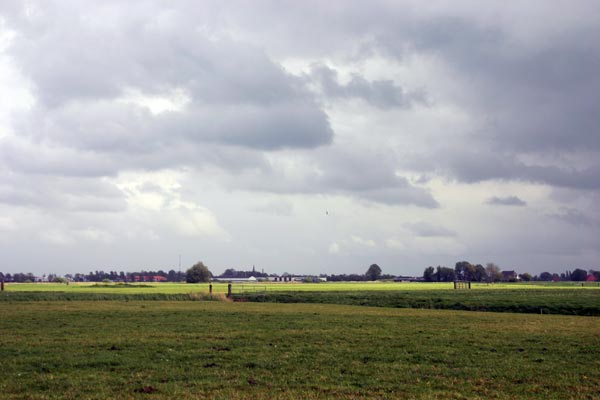
To gain insight in this particular cultural heritage of the countryside, a village will be singled out that remained for a long time (well into the 1970s) and for the greater part economically dependent on cattle farmers. During the project’s initial phase a study, on micro level, will be made of the village of Wjelsryp – chosen because of ease of accessibility; it’s the native village of two of the project’s participants (Wapke Feenstra and Pietsie Feenstra). A village situated in an area with a population growth well below the national average. Wjelsryp currently has 500 inhabitants and 40 years ago it had 400. And though the village culture of Wjelsryp seems to become more open – because of tourism, etc. – it still has a dynamic and memory of its own. Its authenticity lies in the ground. How to transform this into new spatial constructs for the future? And what kind of international projects are there to learn from?
The initial phase of the project will consist of:
1. Collecting of data in the local archives of the village, the land register and by means of soil drillings. The focus will be on ownership relations and manifestations of culture like the church council, Nativity plays, celebrations in honour of a member of the House of Orange and ‘kaats’-festivities (‘kaatsen’ is an old Friesian handball game with some resemblance to cricket). Retrievable up to about 1880. Linking names of participants to work, property and gender. For example: middle class, farmer (owning his own land or not), male or female and profession (commuter or manifesting him/herself in the village). How was a culture created within this scenery of green and grass? Did the location or the type of soil – infertile peat soil or more fertile clay soil – influence the construction of the cultural facilities? What’s the rhythm of a small community? How are ‘games’ and ‘playing fields’ organised here? What’s the function of rituals within the historical frameworks? Did religion influence the make-up of these rituals? What will be the new sense of values when old structures dissolve?
2. How did art and culture actually enter the village from the outside? Data about Wjelsryp will be collected, e.g. use will be made of Red Cross films, the local mobile library, Town Hall performances and other projects by outsiders who managed to join in.
In addition data will be collected from some exemplary projects of present-day architecture and art in the public space. Get the opinion of ‘Public Works’ (see 2e). Which mobile or parasitic architecture advanced present-day cultural exchange in rural areas? How does / did one deal with novel and strange, temporary or permanent, structures invading the countryside? Where were they put, on private or public property? The data will be presented to the think tank.
3. During the initial phase a multi-disciplinary think tank will be set up. The think tank will be multi-disciplinary and will posses knowledge about the European countryside and landscape. At the centre will be the micro-level investigation as a cell from which one can learn. The land / soil as bearer of culture will be a starting point. Diverse insights and disciplines will be juxtaposed. See question 2e for our proposals regarding think tank members. The first exchange will be exploratory and belongs to the initial phase; the think tank could be supplemented by the Netherlands Architecture Fund.
+++++++++++++++++++++++++++++++++++++++++++++++++++++++++++++++++++++
a stay in the country 2002 - 2004
08 April 2004
In May 2003 I mentioned a project in Denmark. A quick reminder: “… in the autumn of 2002 I was invited to take part in a group show in Denmark about (artificial) landscape. Born in the middle of a landscape I decided to get in touch with a poet that lives near Wjelsryp. I did not know him, and got his name over the Fryske Akademy, an institute for language that had advised me before. So I started a correspondence with a stranger who was contemplating the landscape that is so familiar to me. We wrote each other for three weeks and he came up with eight wonderful poems, which I decided to translate. I combined them with other texts I wrote during the show in Denmark. Now I plan to make a little publication.”
This work has been published by now, see: “A stay in the country / Buitenverblijf". In October 2003 the booklet was presented in Sexbierum at Liauckema-State by Beart Oosterhaven at a meeting that was part of “The year of the farm”. He delivered a lecture about living on his small converted farm and told about our project. He read the eight poems about the view from his farm. Later on a radiobroadcast was made in the Wjelsryper landscape, which aired on Omrop Fryslân in the autumn of 2003 and was repeated in the autumn of 2004. The project “A stay in the country” was discussed there in the Friesian language. Through this publicity and subsequent presentations at The Fries Museum (National Museum Weekend 2004) many inhabitants of Wjelsryp and Friesland by now know about the booklet. I want to continue describing the changing landscape surrounding me.
Meanwhile a horse dairy is being set up on the farm where I was born by my sister Maaike and her husband Arie. Part of her veterinary practice was already housed on the farm (see www.hyndolac.nl). These changes underline the reutilization of land and farm in this cattle breeding region. The changes are especially in the details, for at first sight the landscape has changed less over the last 40 years, than the scene of the Erica-square in Rotterdam where I have been living for only 8 years. But when you read the poems by Beart Oosterhaven you will notice how these details lie within his field of vision. And this sensitivity for details regarding one’s surroundings is what interests me.
To be continued.
Wapke Feenstra
+++++++++++++++++++++++++++++++++++++++++++++++++++++++++++++++++++++
About living near Wjelsryp (text from 2003 at the start of OURVILLAGES)
20 May 2003
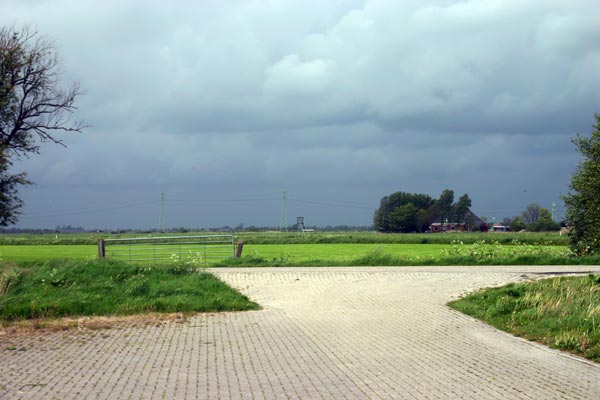
As has been said the area around my village has a tradition in text, poetry, songs, music and so on. There is less connection with the visual arts. Which is why, as a visual artist, I also like to write!? For sure, the Frisian language is connected to my perception of my village and rural life in general. And this is a language I cannot write, only speak. The speech and the declamation of Frisian poetry are the first public cultural moments I remember.
Then there is another aspect that is important in contacts with the village. As the daughter of a farmer that lived a bit outside the village, we had to go there. We were socially connected to the village but not in the middle of it and that was what I liked. To start the project, I thought I would approach it in a way that fits in with my connection to the village. So not by jumping into the middle of it, but slowly making a new (cultural) line with Wjelsryp.
From the moment we talked about how to involve the village in our own art practices, I was aware of making this line. And the line came naturally; in the autumn of 2002 I was invited to take part in a group show in Denmark about (artificial) landscape. Born in the middle of a landscape I decided to get in touch with a poet that lives near Wjelsryp. I did not know him, and got his name over the Fryske Akademy, an institute for language that had advised me before. So I started a correspondence with a stranger who was contemplating the landscape that is so familiar to me. We wrote each other for three weeks and he came up with eight wonderful poems, which I decided to translate. I combined them with other texts I wrote during the show in Denmark. Now I plan to make a little publication of it and will hold a book presentation and a poetry event in the 'village house' (a public community place) with Beart Oosterhaven. Getting in contact with the cultural site of my village in this way is interesting for me because I want to contact people there in a new fresh way. And by including poems that describe their everyday environment in a publication, and later on promoting these observations in a larger field, feels like a good initial connection.
I've always liked daily observations and visions about locations, and this is as you know a very special location for me. And the start of more cultural exchanges with my village!? I'll give you more information soon.
Wapke Feenstra
+++++++++++++++++++++++++++++++++++++++++++++++++++++++++++++++++++++